

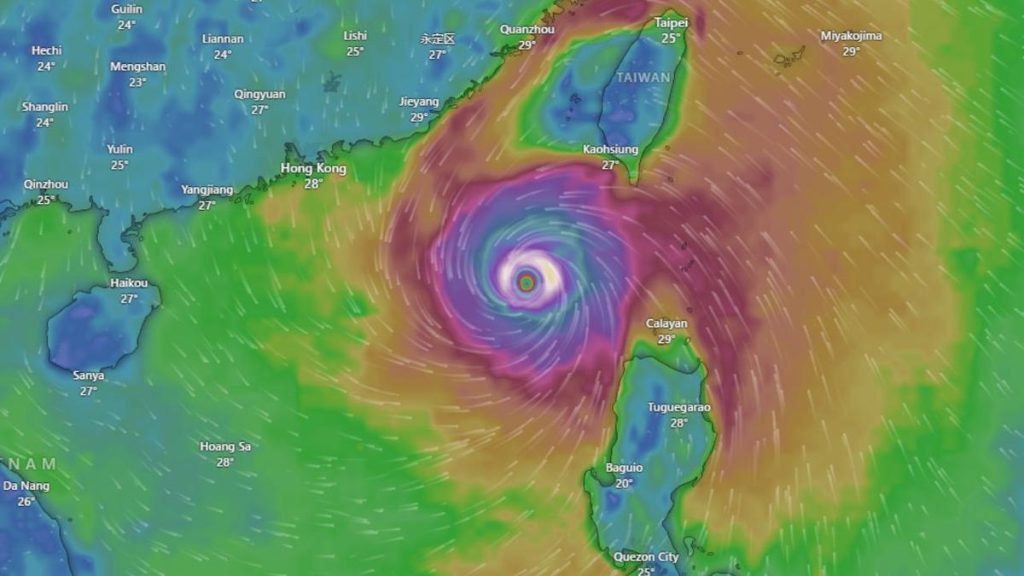
Super Typhoon Ragasa has brought widespread disruption to air and sea routes across Asia, impacting the Philippines, Taiwan, Hong Kong, and mainland China.
Authorities in Taiwan, Hong Kong, and several coastal provinces of China have activated their highest-level emergency response plans as Ragasa lashes the northern tip of Luzon Island in the Philippines.
According to Hong Kong’s weather bureau, Ragasa is moving toward Guangdong Province in southern China, packing sustained winds of up to 220 km/h (136 mph). The Hong Kong government is expected to raise its typhoon warning signal to level 8 by the afternoon of September 23.

Flights and Ferries Suspended Across the Region
Mass evacuations, flight cancellations, and ferry suspensions have been implemented across affected regions. Hong Kong International Airport will suspend all passenger flights for 36 hours, from 8 p.m. on September 23 to 8 a.m. on September 25. Airlines have already begun canceling flights in advance.
So far, about 700 flights have been disrupted, with Cathay Pacific canceling over 500 flights from Tuesday night through Thursday morning. Other international carriers have followed suit, urging travelers to check for real-time updates.
In mainland China, coastal provinces have halted ferry operations and prepared to ground flights. Shenzhen will suspend all air services on the night of September 23, while routes to and from Fujian are being canceled or delayed.
Taiwan has also canceled flights to Penghu, Kinmen, and Matsu, and suspended 88 ferry routes across 13 lines.
Severe Conditions in the Philippines
Powerful waves have been reported off Basco Island in Batanes, northern Philippines, as Ragasa continues to stir violent seas and gusty winds while crossing the Luzon Strait.
Domestic flights to northern cities such as Laoag, Tuguegarao, and Basco have all been grounded. While major airports in Manila and Clark remain open, authorities warn of cascading delays as the storm moves into the South China Sea, threatening Shenzhen and nearby regions. Inter-island ferries in the Philippines have also been suspended for safety reasons.
A Widespread Impact on Asia’s Aviation Network
Experts note that Ragasa’s path and timing have simultaneously disrupted four major aviation hubs — Hong Kong, Taiwan, the Philippines, and mainland China — causing one of the most significant logistical breakdowns in recent years.
The extended closure of Hong Kong International Airport is expected to create a ripple effect on global flight schedules for several days. As a result, airlines are implementing flexible ticket change policies and making large-scale schedule reductions.
Travelers are strongly advised to monitor airline notifications closely and make adjustments as needed.
Passengers flying to or from Hong Kong or Taiwan between September 23 and 25 are encouraged to reschedule through airline apps instead of queuing at airports. Those heading to northern Luzon should confirm flight status before departure.
Travel Advisory for Tourists
Ferry services in Taiwan, Hong Kong, and Fujian will remain suspended during the highest warning levels. Travelers should expect extended delays, prepare backup plans, and stay updated with official weather alerts from local authorities as Super Typhoon Ragasa continues its course.
Storm Formation and Forecast
According to the Disaster Monitoring System, Ragasa developed from a tropical depression on September 18, intensifying into a super typhoon after strengthening nine categories within just four days.
The Northwestern Pacific Ocean has already recorded three other super typhoons this year — Yagi, Gaemi, and Krathon — marking one of the region’s most active storm seasons in recent history.